A respirator is only effective when it fits correctly. Learn how quantitative respirator fit testing works, what employees can expect, and how Accurate Safety Distributors helps businesses verify respirator fit with objective, measurable results.
When employees rely on respirators to protect them from airborne hazards, selecting the right equipment is only the beginning. It’s also critical that:
- The respirator must fit the individual wearer correctly,
- And the wearer must know how to properly put on the equipment.
Even a high-quality respirator can provide inadequate protection if air leaks around the face seal. That’s why respirator fit testing is a critical component of an effective respiratory protection program.
Accurate Safety Distributors (ASD) offers quantitative respirator fit testing using PortaCount technology from TSI Incorporated. We can conduct testing either at our Freeland facility or, depending on your team’s needs and scheduling requirements, at your location. Our goal is to make it easier for employers to verify respirator fit, maintain appropriate records, and support the safety of their employees.
What Is Respirator Fit Testing?
Respirator fit testing evaluates whether a tight-fitting respirator forms an adequate seal against an individual wearer’s face.
Under OSHA’s respiratory protection standard, employees required to use tight-fitting respirators generally must be fit tested:
- Before initial use,
- When they use a different make, model, style, or size of respirator,
- And at least annually thereafter.
- Additional testing may be needed when physical changes could affect respirator fit.
There are two primary methods of fit testing: qualitative and quantitative. Both can be appropriate in specific circumstances, but they use different approaches to evaluate fit.
Qualitative vs. Quantitative Fit Testing
Qualitative fit testing (QLFT) is a pass/fail method that relies on the wearer’s ability to detect a test substance, such as a bitter- or sweet-tasting aerosol. If the wearer detects the test agent during the prescribed exercises, the respirator fails the test.
Quantitative fit testing (QNFT) uses an instrument to measure particulate leakage into the respirator and calculate a numerical fit factor. Rather than relying on taste or another sensory (and subjective) response, it produces an objective measurement of how well the respirator seals against the wearer’s face.
At Accurate Safety, we have chosen to offer quantitative fit testing because the objective, measurable results it provides mean our customers can feel more confident about their worker protection.
Why Choose Quantitative Fit Testing?
Quantitative testing offers several important advantages:
- Objective measurements: The test produces a numerical fit factor rather than relying on a wearer’s ability to detect a test substance.
- Measurable results: Employers receive a result that can be evaluated against the applicable fit-testing criteria for the respirator.
- Broad applicability: Quantitative testing can be used with a variety of compatible tight-fitting respirators, including appropriate N95 masks, half-facepiece respirators, and full-facepiece respirators.
- Support for respiratory protection programs: Fit-test results and records help employers manage respirator assignments, track testing requirements, and document program activities.
The appropriate testing protocol and passing criteria depend on the respirator and applicable requirements. Quantitative testing does not replace proper respirator selection, medical evaluation, training, or the other elements of a respiratory protection program—but it provides a valuable, objective and measurable assessment of fit, in an efficient way.
How Does the TSI PortaCount Fit Tester Work?
Accurate Safety uses TSI PortaCount respirator fit-testing technology to measure respirator fit.
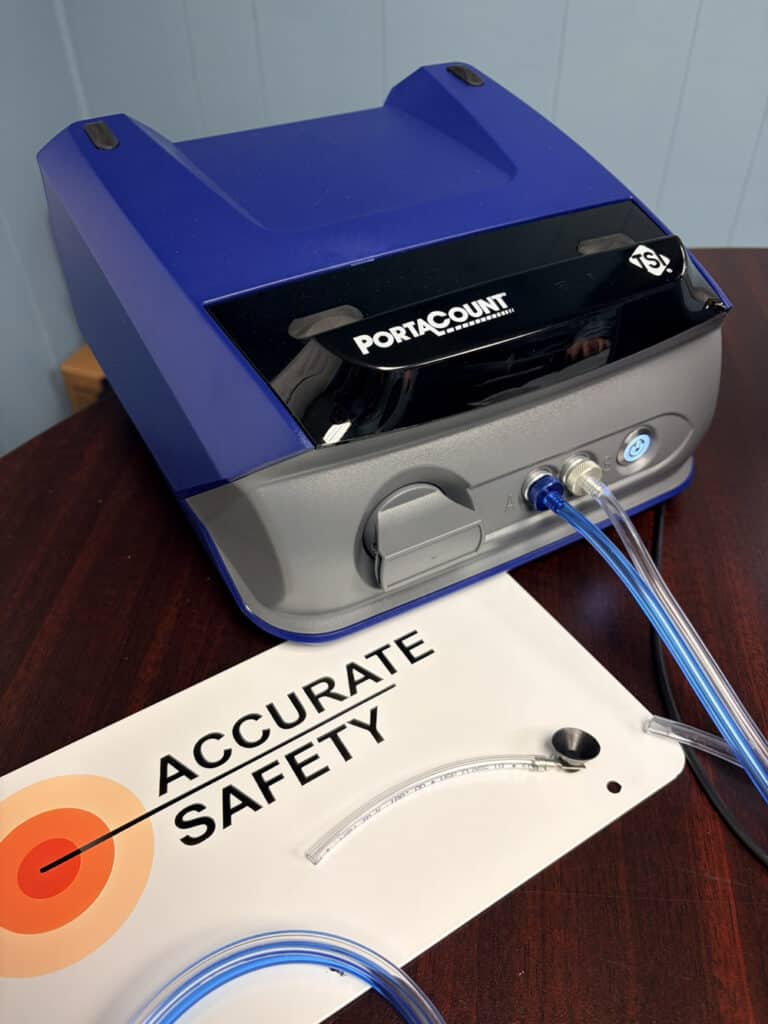
We test at our facility or yours using our Accurate Safety PortaCount Respirator and sanitary disposable sensors (sensor shown here).
First, we affix a sensor to the mask/respirator being tested. We then connect the sensor to the PortaCount measuring instrument. During a series of tests, the PortaCount measures particles in both the ambient air and inside the respirator. By comparing the particle concentrations, the instrument calculates a fit factor that indicates how effectively the respirator seals against the wearer’s face during testing.
The process is designed to evaluate the face seal under a series of prescribed conditions, including movement, breathing, and talking.
To better understand how Accurate Safety conducts its real-time quantitative respirator fit tests, watch this demonstration video featuring the technology team behind the PortaCount Respirator Fit Tester.
The resulting fit factor is compared with the minimum passing criterion established by the applicable protocol and respirator type.
What to Expect During a Quantitative Respirator Fit Test
Knowing what to expect can help employees feel more comfortable and help employers plan their testing sessions.
1. Prepare for Testing
Before testing begins, the employer should identify the respirator make, model, style, and size the employee is expected to use.
Employees must complete the required medical evaluation and receive medical clearance before fit testing, as applicable under OSHA requirements.
Employees should arrive clean-shaven wherever the respirator’s sealing surface contacts the face. Facial hair or other conditions that interfere with the seal can prevent a successful fit test.
2. Put on and Adjust the Respirator
The employee puts on the respirator according to the manufacturer’s instructions. The fit-test administrator checks that it is positioned correctly, and that straps and other components are properly adjusted.
If the respirator is uncomfortable or does not fit correctly, the employee may need to try a different size or model before testing proceeds.
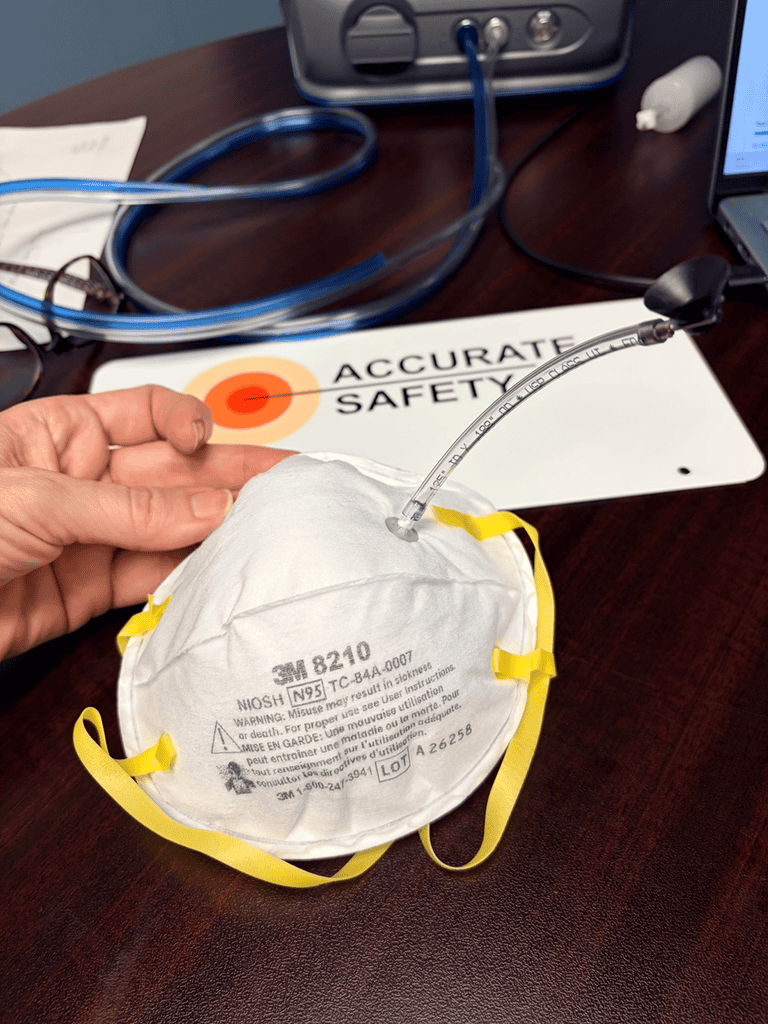
Pictured is an N95 mask with the disposable test sensor attached. Each person gets their own individual sensor and a sterilizing solution continuously sanitizes the tubing in real time during the test.
3. Complete the Test Exercises
Once the respirator is properly fitted, the employee completes the exercises required by the applicable protocol.
These may include:
- Normal breathing
- Deep breathing
- Turning the head from side to side
- Moving the head up and down
- Speaking
- Bending over or performing another prescribed movement
The exercises help assess whether the respirator maintains an adequate seal as the wearer moves and breathes.
During the test, the PortaCount measures particle concentrations inside and outside the respirator to calculate the fit factor. The results show in real-time on a video screen in an easy-to-understand visual dashboard.
4. Review the Results
At the conclusion of the test, the result is evaluated against the applicable passing criteria.
If the employee passes, the result helps verify that the tested respirator model and size achieved the required fit under the test conditions.
If the employee fails, the administrator may need to check the respirator’s positioning, try a different model or size, and repeat the test as appropriate.
A failed test is useful information! It means that the respirator has not demonstrated the required fit and that further action is needed before the employee uses it under the applicable respiratory protection program.
5. Document the Fit Test
Documentation is an important part of managing a respiratory protection program.
OSHA requires employers to maintain fit-testing records that include the employee’s name or identification, the type of test performed, the respirator make, model, style and size, the test date, and the results, as applicable.
Quantitative fit-testing records include the fit factor and other information required by the applicable protocol.
Accurate records help employers track testing schedules, manage respirator assignments, and demonstrate that required fit testing has been completed.
Convenient Fit Testing at Your Facility or Ours
Coordinating fit testing for a workforce can be challenging, especially when employees work across multiple shifts, departments, or job sites.
Accurate Safety Distributors offers quantitative respirator fit testing at our Freeland, Michigan facility and at customer locations, helping businesses choose an arrangement that fits their operational needs. Contact us for details and to arrange services.
Explore our respiratory protection products to find respirators and other equipment for your workplace safety needs.
Testing at Accurate Safety: Arrange for employees to come to our facility for their scheduled fit tests.
On-site testing at your location: Our team can conduct testing at your facility or job site, helping simplify coordination for groups of employees. To learn if this is right for you, contact us.
Whether you’re planning annual fit testing, preparing new employees to use respirators, or addressing a change in respirator selection, we can discuss your requirements and help coordinate the process.
Availability, scheduling, and on-site arrangements can be discussed with our team.
Make Quantitative Respirator Fit Testing Part of Your Safety Program
Respirator fit testing is more than a compliance task. It helps verify that the respirator selected for an employee actually achieves the required fit and supports the broader effort to protect workers from airborne hazards.
With TSI PortaCount quantitative fit-testing technology, Accurate Safety Distributors provides employers with objective, measurable fit-test results and a practical option for coordinating testing at their facility or ours.
Ready to schedule respirator fit testing for your team?
Contact Accurate Safety Distributors to discuss your workforce size, respirator types, location, and scheduling needs. We’ll help you determine the next steps for arranging quantitative fit testing.
Frequently Asked Questions
How often do employees need respirator fit testing?
Under OSHA’s respiratory protection standard, fit testing is generally required before initial use, at least annually thereafter, and when an employee uses a different respirator make, model, style, or size. Additional testing may be necessary when physical changes could affect fit (e.g. changes in weight, or facial structure).
Is quantitative fit testing required for every respirator?
Not necessarily. The appropriate method depends on the respirator, its intended use, workplace exposures, and applicable requirements. Quantitative fit testing is required in certain circumstances, while qualitative testing is permitted for eligible respirators under specified conditions. We prefer the quantitative because the data is clearer versus the potential subjectivity of a qualitative test.
What is a fit factor?
A fit factor is a numerical measure derived from the relationship between particle concentrations both outside and inside the respirator during quantitative testing. The minimum passing fit factor depends on the respirator and applicable protocol.
Can you fit test employees at our facility?
Yes. Accurate Safety Distributors offers quantitative respirator fit testing at our Freeland, Michigan facility and at customer locations. Contact us to discuss your workforce, location, and scheduling requirements.
Does passing a fit test guarantee complete respiratory protection?
No. A passing result demonstrates that the tested respirator achieved the required fit under the test conditions. Effective respiratory protection also depends on proper respirator selection, medical clearance, training, correct use, maintenance, and an appropriately administered respiratory protection program.
What respirators do you test?
At Accurate Safety Distributors, we conduct quantitative testing on:
- All N95 Disposable Respirators
- 3M ½ Mask Respirators
- 3M Full Face Respirators